Hydroxyapatite in fluoride-free oral care

Discover why hydroxyapatite is emerging as a leading fluoride-free solution for enamel remineralization and protection.

Flouride-free oral care
Share

Why fluoride remains the benchmark in oral care

For more than half a century, fluoride has been a reference of preventive oral care. Its ability to enhance enamel resistance to acid attacks, support remineralization and reduce dental caries has made it one of the most studied and clinically validated active ingredients in oral health. Public health authorities and dental professionals worldwide continue to recognize fluoride toothpaste as an effective and accessible tool for caries prevention. (European Commission, 2026); (Paszynska, 2023)

As a result, fluoride-containing toothpastes remain the benchmark against which new remineralization technologies are evaluated. At the same time, evolving consumer preferences are creating interest in alternative approaches that align with trends such as natural ingredients, biomimetic technologies and fluoride-free formulations.

Among the technologies attracting the greatest attention, hydroxyapatite has emerged as a promising biomimetic ingredient for fluoride-free oral care. (Unterbrink, 2026) (Paszynska, 2023)
The rise of fluoride-free oral care

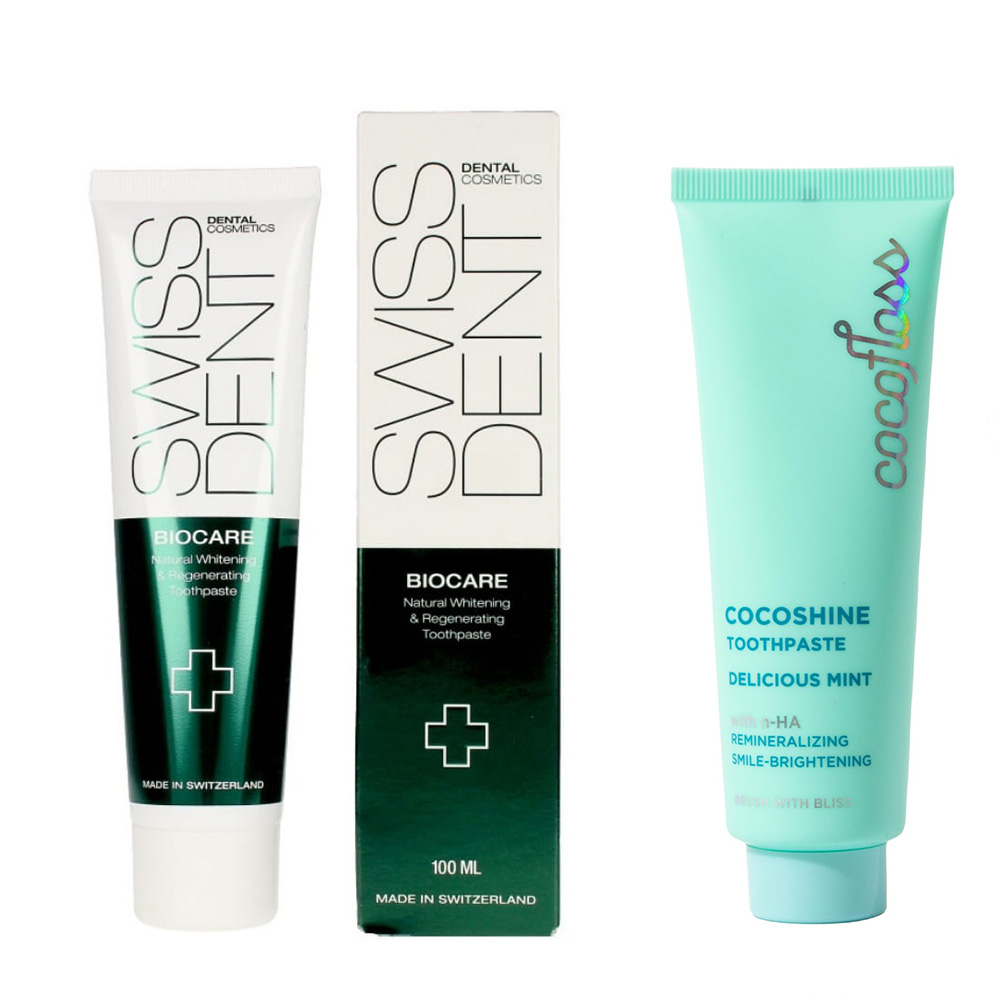
While fluoride continues to play an important role in preventive oral care, fluoride-free products are gaining visibility across global markets. Recent toothpaste launches increasingly incorporate explicit fluoride-free claims, reflecting a broader movement toward natural, clean-label and gentle oral care solutions. (Mintel, 2025)

For many consumers, fluoride-free is not necessarily about rejecting fluoride. Instead, it is often associated with ingredient transparency, minimalist formulations and naturally inspired approaches to oral health. Brands frequently combine fluoride-free positioning with “free-from” claims related to sulfates, parabens or other ingredients perceived as undesirable. (Mintel GNPD, 2026)

The trend is also being amplified by ongoing public discussions around fluoride use. In Europe, sodium fluoride is currently undergoing regulatory review following a harmonized classification proposal submitted to ECHA, while debates surrounding water fluoridation continue in parts of the United States. Although these developments do not change the established role of fluoride in caries prevention, they have increased consumer awareness and encouraged manufacturers to explore additional oral care solutions. (European Chemicals Agency, 2026)

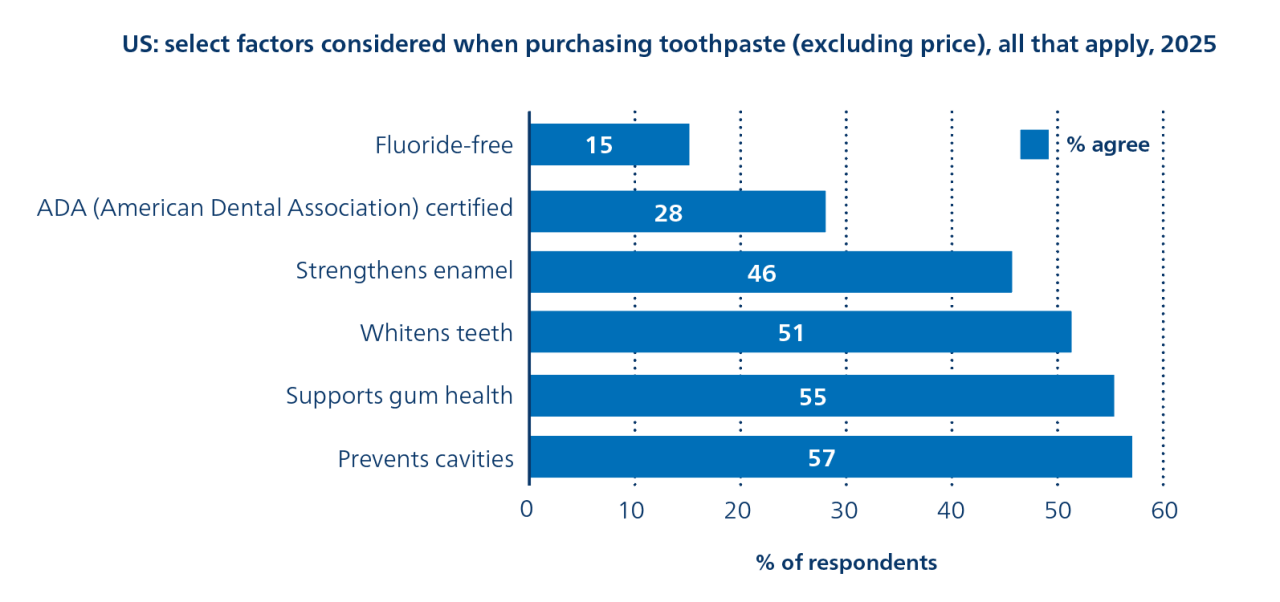
Consumer interest is becoming increasingly measurable. In 2025, 15% of US toothpaste users reported considering fluoride-free options when purchasing toothpaste, highlighting the growing relevance of the category. Importantly, this shift does not appear to reflect a reduced interest in efficacy. Consumers continue to prioritize cavity prevention and enamel strengthening, suggesting that fluoride-free alternatives will need to deliver meaningful and scientifically supported oral health benefits. (Mintel, 2025)

Figure 1. Examples of fluoride-free and clean-label positioning: Swissdent Biocare and Cocofloss Cocoshine (Mintel GNPD, 2026) Figure 1. Examples of fluoride-free and clean-label positioning: Swissdent Biocare and Cocofloss Cocoshine (Mintel GNPD, 2026)
Figure 2. Consumer factors considered when purchasing toothpaste in the US (Mintel, 2025) Figure 2. Consumer factors considered when purchasing toothpaste in the US (Mintel, 2025)

For formulators, this means balancing two expectations that do not always go hand in hand: meeting clean-label preferences while still delivering the level of enamel protection and remineralization consumers expect from a modern toothpaste.

Hydroxyapatite: from emerging ingredient to established fluoride-free alternative

As brands search for credible fluoride-free solutions, hydroxyapatite has emerged as one of the most prominent active ingredients in the category. Numerous premium oral care brands now highlight both hydroxyapatite and fluoride-free positioning on pack, reflecting growing confidence in technology. (Mintel GNPD, 2026)

Part of hydroxyapatite's appeal comes from its biomimetic nature. Hydroxyapatite is the primary mineral constituent of tooth enamel, making it a natural candidate for technologies designed to support enamel repair and remineralization. (Paszynska, 2023) (Reguzzoni, Carganico, & Lo Presti, 2025)

Beyond its commercial success, hydroxyapatite is also supported by a growing body of clinical evidence. In an 18‑month randomized clinical trial, a fluoride-free hydroxyapatite toothpaste demonstrated caries-prevention outcomes that were not statistically inferior to a toothpaste containing 1450 ppm fluoride. (Paszynska, 2023)

More recently, a systematic review identified hydroxyapatite as one of the few non-fluoride technologies supported by clinical caries-prevention studies across different age groups. (Unterbrink, 2026)

As interest in hydroxyapatite continues to grow, innovation is increasingly focused on optimizing hydroxyapatite itself, with manufacturers exploring new particle designs and mineral architectures to further enhance enamel remineralization and protection.

A differentiated hydroxyapatite ingredient: Omyadent® 100

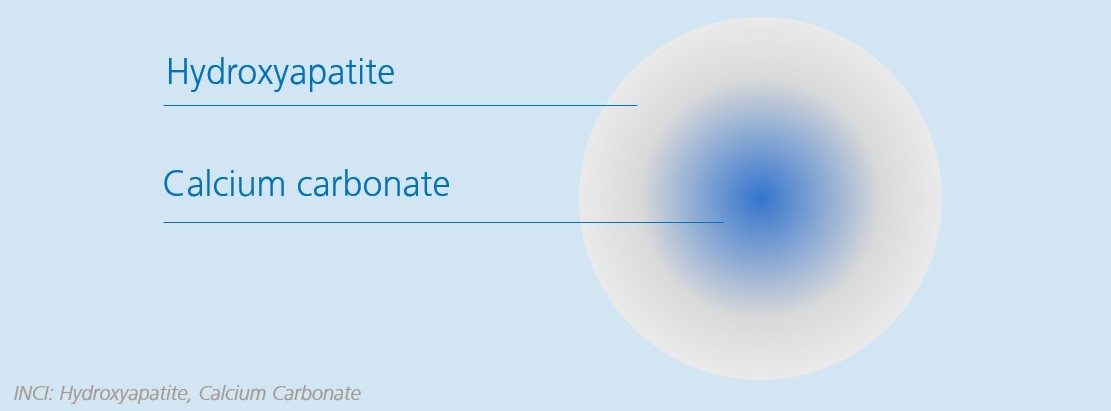
Omyadent 100 is one example of this evolution. While it relies on hydroxyapatite as the main remineralizing component, it also incorporates Omya's proprietary Functionalized Calcium Carbonate (FCC) technology, resulting in a co-crystallized mineral structure in which hydroxyapatite and calcium carbonate are integrated within a single particle (Figure 6). (Omya International AG, 2026)

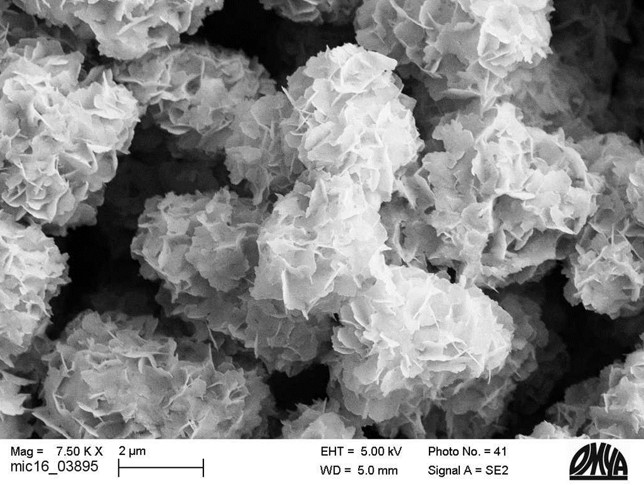
Omyadent 100 contains a high proportion of hydroxyapatite (~90%) and an interconnected porous network. This structure provides a large active surface area to encourage interactions with both the tooth surface and oral fluids, without relying on nano sized particles. By increasing exposure of the mineral phase and facilitating the release of remineralizing ions, it creates favorable conditions for mineral redeposition within demineralized enamel. (Omya International AG, 2026)

As a result, Omyadent 100 represents an evolution within the hydroxyapatite category, combining a biomimetic mineral composition with a particle architecture designed to enhance remineralization performance.

Figure 6.  Functionalized Calcium Carbonate Technology (FCC)                             Figure 3. Functionalized Calcium Carbonate Technology (FCC)
Figure 7. SEM Omyadent 100 Figure 4. SEM Omyadent 100

From mineral engineering into enamel performance

To assess whether these structural differences translate into improved enamel protection and remineralization, the performance of Omyadent 100 was evaluated using established pH-cycling models designed to simulate the demineralization and remineralization processes occurring in the oral environment.

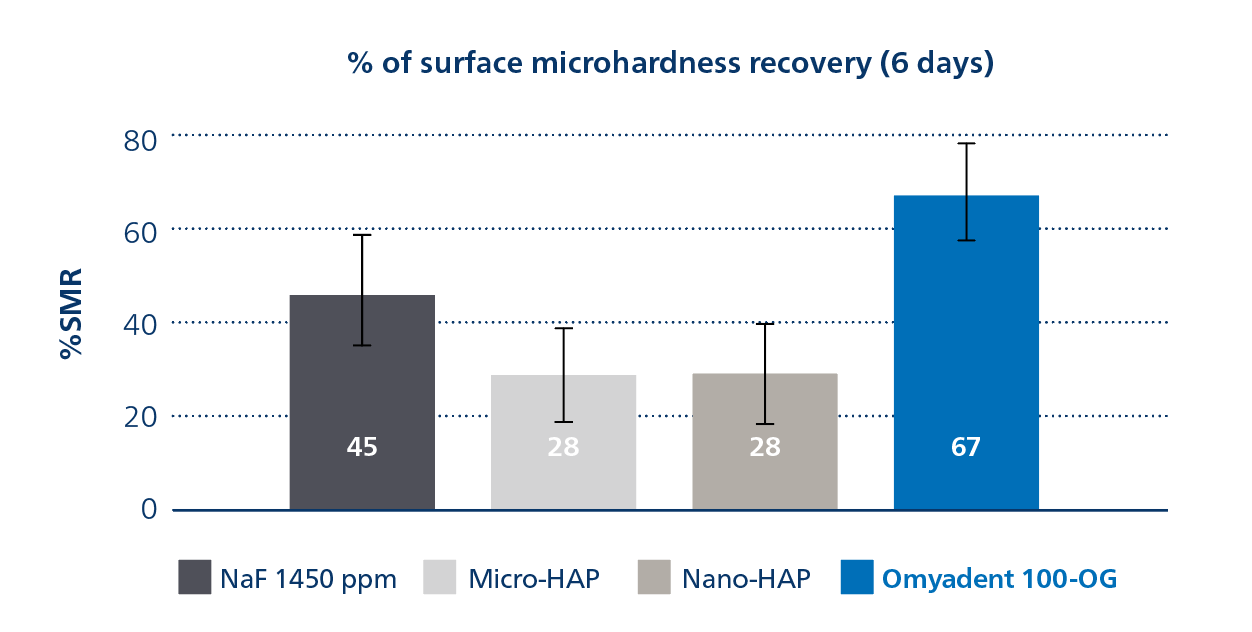
In a surface microhardness recovery (SMHR) study, 5% Omyadent 100 demonstrated substantially higher enamel remineralization than both micro- and nano-hydroxyapatite reference materials under the tested conditions. The study also included a 1450 ppm sodium fluoride benchmark, against which Omyadent 100 achieved higher surface microhardness recovery in average. (Omya International AG, 2019)*

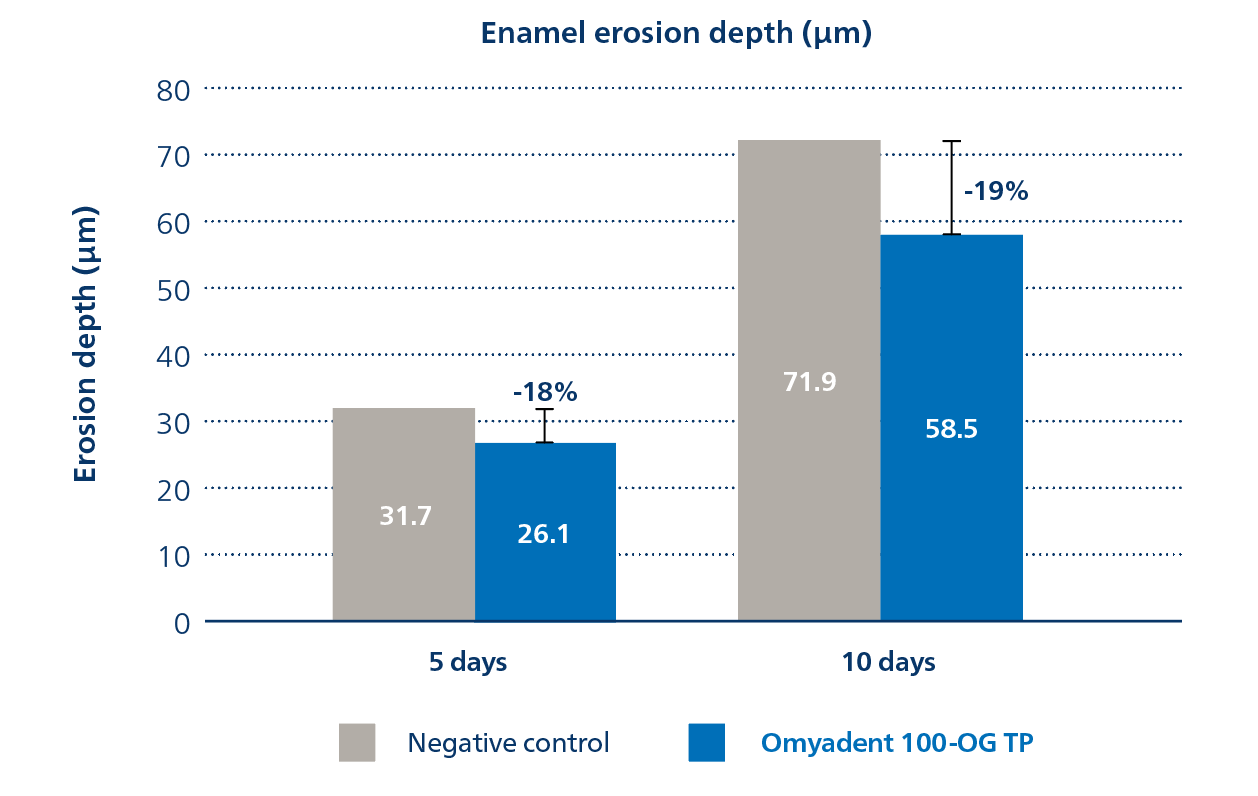
Beyond remineralization, Omyadent 100 was also evaluated for its ability to protect enamel under acidic conditions. In a separate pH-cycling study designed to simulate repeated acid challenges, formulations containing 5% Omyadent 100 reduced enamel loss compared with untreated controls, demonstrating protection against erosion over the duration of the experiment. (Omya International AG, 2019)*

* Importantly, all results presented were obtained in controlled laboratory studies using pH-cycling models intended to simulate oral conditions and should not be interpreted as direct clinical outcomes.

Figure 8. Enamel remineralization performance of Omyadent 100 compared with sodium fluoride, micro-hydroxyapatite and nano-hydroxyapatite in a pH-cycling model. Figure 5. Enamel remineralization performance of Omyadent 100 compared with sodium fluoride, micro-hydroxyapatite and nano-hydroxyapatite in a pH-cycling model.
Figure 9. Reduction of enamel erosion under acid challenge following treatment with Omyadent 100. Figure 6. Reduction of enamel erosion under acid challenge following treatment with Omyadent 100.

The next generation of fluoride-free formulations

Over the past few years, hydroxyapatite has moved from a niche ingredient to a recognized option within the fluoride-free oral care market. As adoption increases, manufacturers are looking beyond simple ingredient claims and placing greater importance on measurable enamel benefits and scientific evidences.

The studies presented in this article illustrate how material design can influence hydroxyapatite performance. By combining hydroxyapatite with FCC technology in a single co-crystallized structure, Omyadent 100 was developed to enhance mineral availability and support enamel remineralization and protection.

Fluoride will likely remain the reference standard for caries prevention for the foreseeable future. However, the continued growth of fluoride-free oral care creates opportunities for technologies that can provide strong scientific support while answering evolving consumer expectations around ingredient choice and formulation transparency.

References

European Chemicals Agency. (2026). Registry of CLH Intentions Until Outcome: Sodium Fluoride. From https://www.echa.europa.eu/registry-of-clh-intentions-until-outcome

European Commission. (2026). Fluoride and Oral Health. From https://health.ec.europa.eu

Juntavee, N., Juntavee, A., & Plongniras, P. (2018). Remineralization Potential of Nano-Hydroxyapatite on Enamel and Cementum Surrounding the Margin of CAD/CAM Ceramic Restorations. International Journal of Nanomedicine.

Maddah, F., Shirinzad, M., & Khalafi, Z. (2023). Synthesis and Characterization of Hydroxyapatite Nanoparticles and Their Effects on Remineralization of Demineralized Enamel in the Presence of Er,Cr:YSGG Laser Irradiation. BMC Oral Health.

Mintel. (2025). A Year of Innovation in Oral Care 2025. 

Mintel. (2025). Ingredient Watch: Oral Health in Food and Drink. 

Mintel GNPD. (2026). Oral Care Product Launches Featuring Fluoride-Free Claims. 

Omya International AG. (2019). Fraunhofer Institute Study: Enamel Erosion Protection Assessment of Omyadent 100. 

Omya International AG. (2019). Intertek pH-Cycling Study: Evaluation of Enamel Remineralization Performance of Omyadent 100. 

Omya International AG. (2026). Omyadent 100 Technical Deck. 

Paszynska, E. (2023). Anti-Caries Efficacy of a Hydroxyapatite Toothpaste Compared with Fluoride Toothpaste: Results from an 18-Month Randomized Clinical Trial. Frontiers in Public Health.

Reguzzoni, R., Carganico, A., & Lo Presti, D. (2025). Assessment of the Effects of Enamel Remineralization After Treatment with Hydroxyapatite Active Substance: SEM Study. Applied Sciences.

Unterbrink, M. (2026). Fluoride-Free Toothpastes and Caries Prevention: A Systematic Review of Alternative Active Ingredients. Clinical, Cosmetic and Investigational Dentistry.

Curious to expand your knowledge?

Click here to read more and stay updated with the latest articles!