Sludge management costs: the hidden driver of wastewater treatment OPEX
Wastewater treatment plants often focus on treatment efficiency, permit compliance and chemical costs. Yet one of the largest and most overlooked operating expenses may lie elsewhere: sludge handling, dewatering, transport and disposal.
The primary function of a (municipal) wastewater treatment plant (WWTP) is to treat the wastewater, to make it suitable for discharge in accordance with discharge requirements. In this view sewage sludge is an ambivalent ‘by-product’: on the one hand, it is a valuable raw material enabling the production of biogas and fertilisers; on the other hand, it is waste, the treatment and disposal of which involve significant investment and operating costs. As regulatory requirements get stricter, the ability to use sludge and the nutrients inherent in this waste stream becomes more and more difficult, leaving operators with only one option – further treatment, maximum dewatering and then disposal.
How much does sludge really cost a wastewater treatment plant?
Two main types of sludge arise in WWTPs: primary sludge, consisting of settleable solids that are separated before the wastewater enters the biological treatment step, and secondary sludge, arising from the biological treatment stage. We focus on the latter when discussing the effect of dosing chemicals into the aeration tank.
The amount of surplus sludge produced during the biological wastewater cleaning process depends on the volume flow of the wastewater and its organic load (COD):
According to recognized texts on WWTP technology, such as DWA worksheet A 131, the amount of fresh sludge is approximately 1–2% of the municipal wastewater volume flow. Considering the organic wastewater load, the degradation of 1 kg COD produces 0.3–0.6 kg DM (dry matter) of surplus sludge, which has a DM content of about 1–4%.
In addition to general water consumption, the annual volume of sewage sludge produced in individual countries depends on the extent to which municipalities are connected to state-of-the-art WWTPs. In 2020, the global sludge production of municipal WWTPs is stated to amount to 45 million tons dry matter (DM) per year [3].
When sludge becomes one of the largest operating expenses
Simply because of its high moisture content, dewatering the sludge is absolutely essential, regardless of its subsequent use, in order to reduce its volume and thus save on transport costs. Besides the aeration of the biological treatment stage of the WWTP, the handling and treatment of sludge, especially dewatering and drying, are critical for the total energy costs of the entire plant.
For sludge-related costs, there is a rule of thumb whose origin is attributed to wastewater expert Karl Imhoff [4]. He suggested that sludge treatment can account for roughly one third of the total operating costs of a wastewater treatment plant.
The actual costs of sludge management at a WWTP depend, first and foremost, on the strategy for further recovery or disposal. According to different sources [5, 6], disposal costs vary widely, from a minimum of about €25/t for direct application on agricultural land to several hundred €/t for incineration. Due to increasing regulatory restrictions, agricultural use is declining in Europe. Furthermore, landfilling has been forbidden for more than ten years in several countries (Germany, Austria, Switzerland and the Netherlands), while others impose strict restrictions.
However, figures in the order of €300/t or more for disposal via incineration often do not include any revenue from the energy produced or valuable substances recovered, such as phosphorus. Where anaerobic digestion is used, the resulting biogas can also be converted into heat and electricity for use within the treatment plant, helping to offset part of its energy demand. Additionally, fees for incineration or landfill disposal vary according to the availability of these facilities and the distances over which the dewatered sludge must be transported.
The dilemma: the dry matter content of the dewatered sludge is a key factor in disposal costs, but for every percentage point of dry matter gained, the costs of dewatering rise, particularly in terms of energy and chemical additives. In addition to complying with statutory requirements, public wastewater treatment authorities are obliged, as part of their public service remit, to organise wastewater cleaning including sludge treatment as cost-effectively as possible.
The challenge for plant operators is therefore not only to reduce sludge volumes, but also to optimise sludge characteristics before dewatering and disposal.
How process chemistry influences sludge treatment costs
While sludge treatment costs are often associated with dewatering, transport and disposal, they can also be influenced much earlier in the treatment process. WWTPs use chemicals in different treatment stages to help fulfil treated wastewater requirements, stabilise biological processes and improve overall treatment performance. However, these process decisions can also affect sludge characteristics and, ultimately, sludge management costs.
The natural calcium carbonate product Omya Optical primarily serves to stabilize the pH in the aeration tank within the range of 7–8. This is necessary because hydrogen ions produced during the nitrification reaction reduce the pH value. This is harmful to nitrifying bacteria and brings the breakdown of ammonium to a standstill.
The reaction of calcium carbonate with the CO2 present in the water (mainly due to the biological degradation of organic wastewater constituents) leads to the formation of bicarbonate. This provides an effective buffer that-helps counter acidification and maintain a stable pH range in the aeration tank.
Furthermore, calcium carbonate can be used to assist with phosphate precipitation, in conjunction with lime milk, iron or aluminium salts. Beyond its role in process stability and nutrient removal, calcium carbonate may also influence sludge characteristics, which in turn can affect downstream dewatering performance and sludge handling costs.
How sludge characteristics influence dewatering performance
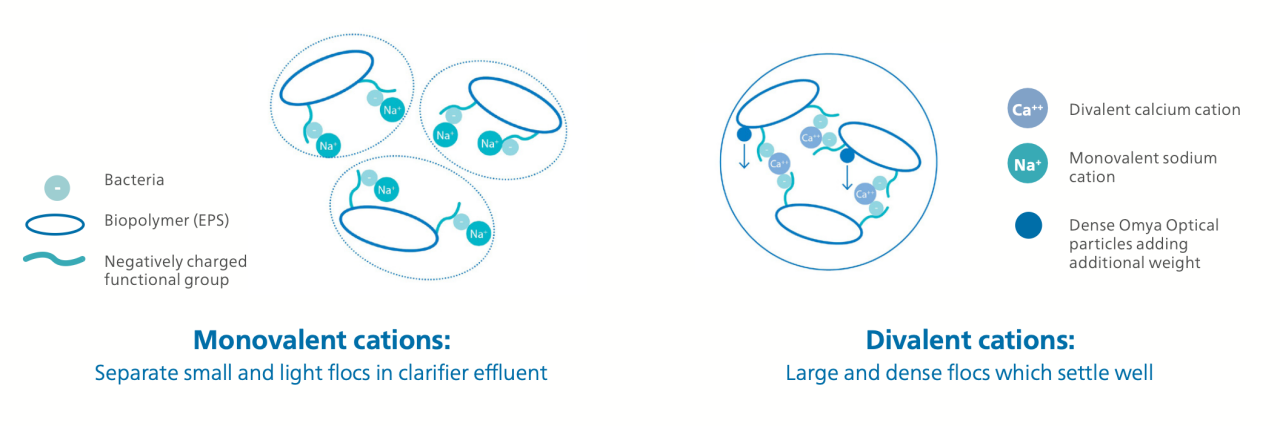
In addition to helping the biomass operate optimally for nutrient removal, calcium ions improve sludge characteristics. Because of their double positive charge, they strongly attract the negatively charged functional groups of sludge polymers and form larger, denser flocs that settle very well (see Fig.1)
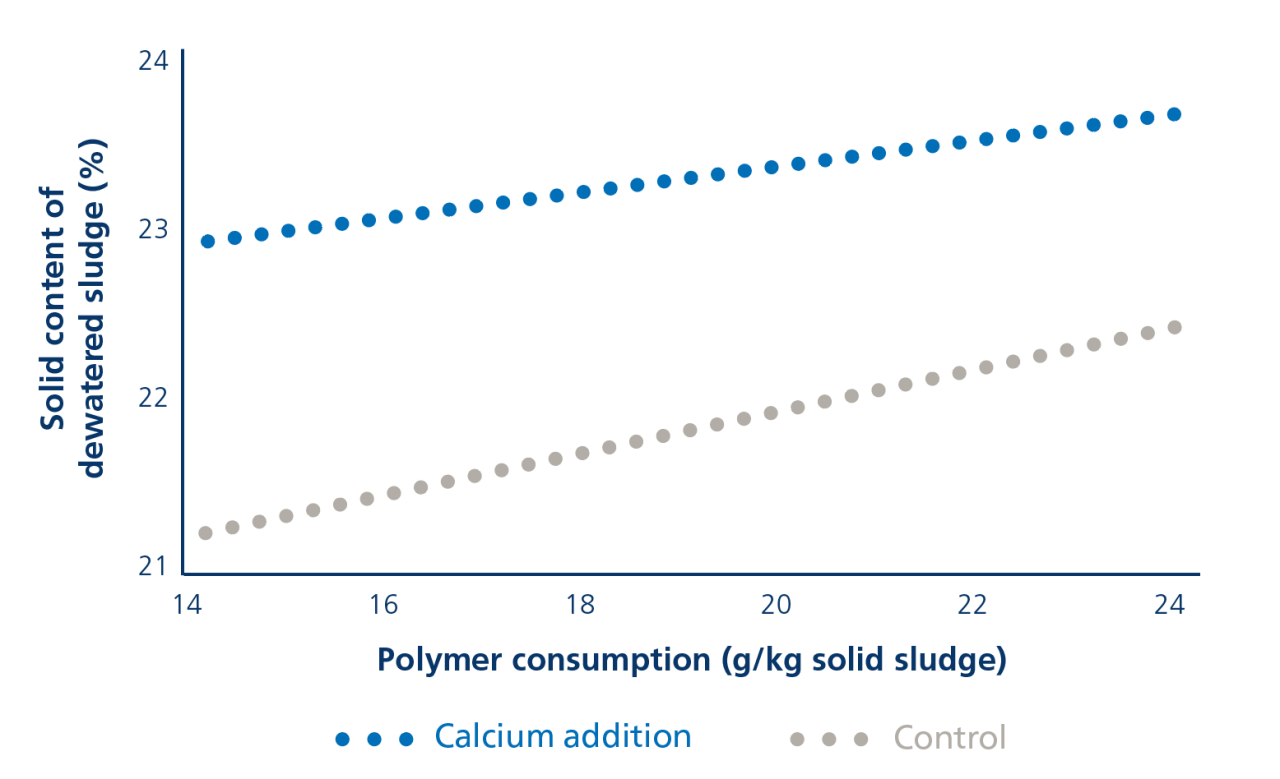
Importantly, improved dewaterability is an additional benefit rather than the sole reason for using calcium carbonate. Where calcium carbonate is already used to stabilise the biological process, improved dewaterability may provide an additional downstream economic benefit.
This benefit can be particularly relevant when calcium carbonate replaces caustic soda for pH control, as improving the calcium-to-sodium ratio can support better sludge characteristics and dewaterability.