Liming as a sustainable practice

Can smarter soil pH management really boost yields, cut emissions, and reduce input costs? Discover how ultrafine liming is transforming sustainable agriculture.

Human hands holding a crop

The agriculture sector is under increasing pressure to enhance productivity while simultaneously meeting stringent environmental and climate objectives. Soil conditioning, particularly through liming with ultrafine mineral products such as Omya Calciprill and Omya Magprill, presents an efficient pathway to enhance soil health and crop productivity while contributing to climate mitigation. This article outlines three key sustainability benefits of soil conditioning with ultra-fine granulated soil conditioners: reduced input requirements, improved fertilizer efficiency, and mitigation of greenhouse gas emissions through optimal pH regulation.

Reduced liming inputs through ultrafine particle technology

Traditional liming practices often rely on high application rates of coarse materials such as aglime, which are less reactive due to lower purity, their larger particle size and thus limited reactive surface area. Omya Calciprill, by contrast, is a micronized and granulated calcium carbonate product that achieves effective soil pH correction at significantly lower application rates - typically 500-1,000 kg/ha compared to several tons per ha for coarse aglime.  

This reduction in input volume translates into substantial operational and environmental savings. Lower quantities mean reduced transportation, less fuel consumption, and minimized labor for field application. This contributes directly to lower emissions from logistics and machinery use. 

Empirical data from field trials conducted at Brisa Agricultural University in India demonstrated that Omya Calciprill increased maize yields by 22–23% at one-quarter the application rate of Dolomitic aglime, indicate that Calciprill enables a 75% reduction in inputs for transportation and field application. 

See our trial results

 Omya Calciprill: ultra-fine, granulated particlesAglime: coarse material 
Product surface area
High
Low 
Product reactivity
High
Low 
Application rate
Low (500-1,000kg/ha)
High (2,000-4,000kg/ha)
CO₂ emissions related to transport & applicationLowHigh

Enhanced fertilizer efficiency through pH optimization

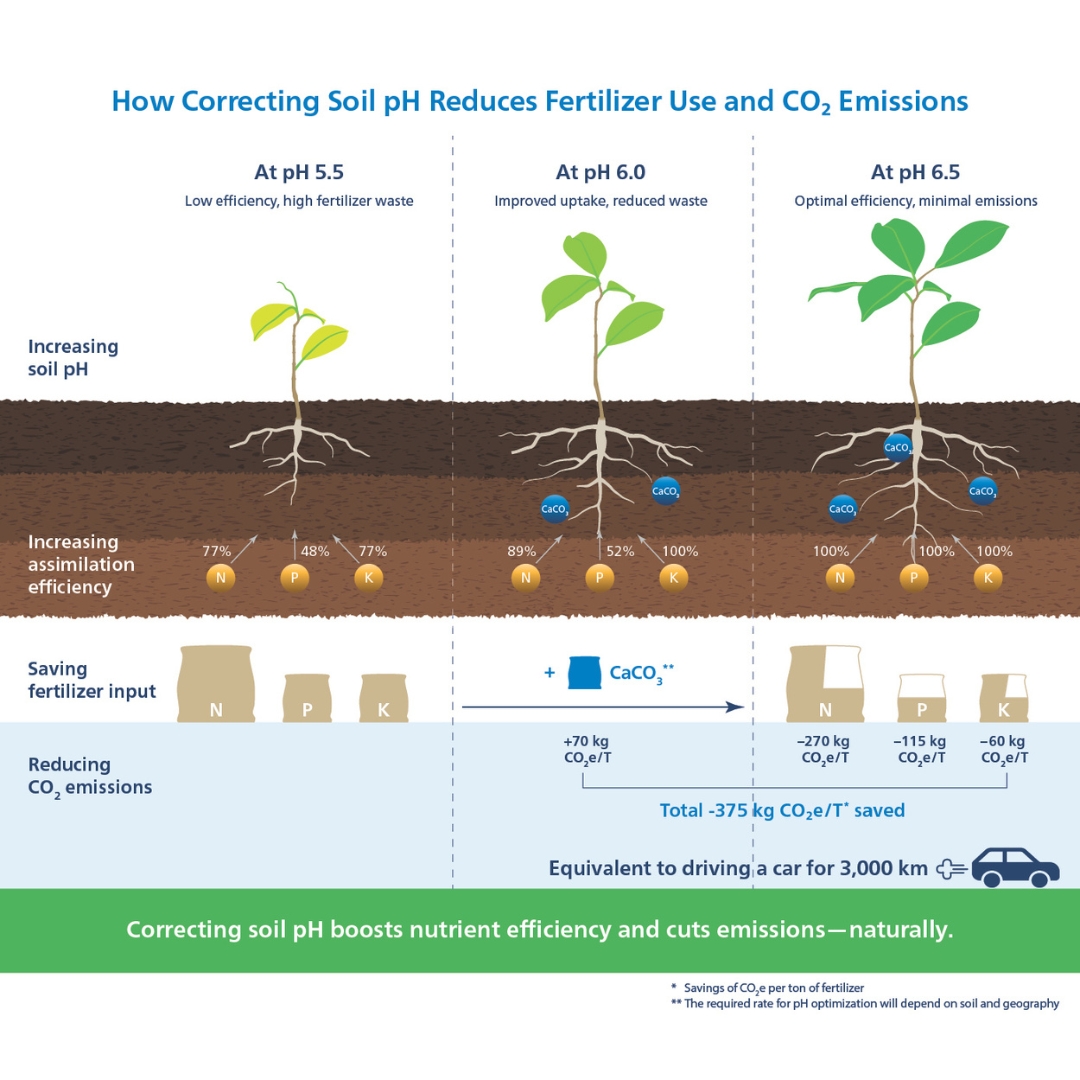
Soil pH is a critical determinant of crop nutrient availability and uptake. Acidic soils hinder plant uptake of key macronutrients - namely nitrogen (N), phosphorus (P), and potassium (K) - leading to suboptimal fertilizer performance and increased environmental losses. By elevating soil pH to an agronomically optimal value of pH 6.5, nutrient retention and uptake efficiency are improved.

Scientific data indicate that adjusting soil pH from 5.5 to 6.5 can significantly reduce nutrient losses—by approximately 25% for nitrogen, 50% for phosphorus, and 25% for potassium. These improvements not only lower input costs for farmers and minimize fertilizer leaching but also contribute to reducing the carbon footprint associated with fertilizer production and application. For instance, producing one ton of urea emits around 1,070 kg CO₂e, whereas finely ground calcium carbonate releases only 70 kg CO₂e per ton (Brentrup et al., 2018). Maintaining optimal soil pH thus offers both economic benefits for farmers and environmental advantages through reduced CO₂ emissions.

Trials with Omya Magprill applied at 985 kg/ha increased crop yields by 34% under full NPK fertilization. Reducing the fertilizer program by 25% still showed a 28% increase in yield. These findings illustrate that optimized soil pH can compensate for reduced fertilizer use, maintaining productivity while minimizing environmental impact.

 Improving soil pH boosts Graph

Optimal soil pH for reduced GHG emissions

Beyond nutrient efficiency, soil pH plays a pivotal role in regulating microbial processes that influence GHG emissions. Acidic soils promote incomplete denitrification, resulting in elevated nitrous oxide (N₂O) emissions - a greenhouse gas with a global warming potential nearly 300 times that of carbon dioxide (CO₂). L By neutralizing soil acidity, liming can significantly reduce N₂O emissions, making it a powerful tool for climate-smart agriculture.

Studies across Europe reviewed by Politecnico di Milano show that increasing soil pH through liming can cut N₂O emissions by around 30%, while also increasing soil carbon storage and methane uptake. The net GHG balance showed a reduction of 118 tCO₂eq/ha/year - equivalent to the annual emissions of 18 cars each driving 50,000 km. Similar a large-scale field study in Ireland found that increasing soil pH in grasslands led to a 39% reduction in N₂O emissions, contributing to a national reduction of 95k tCO₂eq/year (Zurovec et al., 2021). 

Recent research also highlights the potential contribution of liming to durable carbon dioxide removal (CDR). Studies from Yale University demonstrate that finely ground calcium carbonate applied to croplands can enhance natural weathering processes, converting atmospheric CO₂ into stable bicarbonate ions. These ions are retained in soils or exported to aquatic systems, where they may contribute to long-term carbon storage. By maintaining optimal soil pH through liming, croplands can thus support carbon sequestration and help reduce CO₂ emissions as proposed by Raymond et al 2025.

Conclusion: Liming as a scientifically grounded approach to sustainable agriculture

The transition to climate-smart agriculture necessitates the adoption of practices that are both agronomically effective and environmentally responsible. Soil conditioning with Omya Calciprill and Omya Magprill exemplifies such an approach, offering quantifiable benefits in terms of input reduction, nutrient efficiency, and GHG mitigation.

Leveraging ultrafine particle technology and precision application enables farmers to achieve soil pH targets with minimal resource expenditure. The resulting improvements in fertilizer performance and emissions reduction underscore its value as a strategic tool in sustainable land management.

 As agriculture adapts to climate challenges, proven solutions like Omya Calciprill and Omya Magprill will help farmers build stronger, more productive, and climate-friendly farming systems.

Interested in learning more about our agriculture solutions? Contact us today!

Curious to expand your knowledge?

Click here to read more and stay updated with the latest articles!