
Calcium is sometimes treated as a “commodity nutrient” because it is widely available and inexpensive. But for feed producers, nutritionists, and distributors, calcium is anything but simple. It is a foundational macro mineral that shapes performance, welfare, and product quality across species, and its effectiveness depends strongly on how it is supplied.
What’s often overlooked is that not all calcium carbonate behaves the same in the animal, and the differences start long before it reaches the feed mill.
Calcium: a fundamental nutrient with system-wide impact
Calcium is the most abundant mineral in the animal body, driving bone strength, muscle contraction, nerve function, blood clotting, enzyme activation, and metabolic regulation. Because of these diverse roles, calcium status influences measurable outcomes such as bone and eggshell quality, milk performance, feed efficiency, and overall resilience.
Across species, requirements differ sharply. Layers rely on calcium for continuous eggshell formation, dairy cows need it to support milk production and maintain homeostasis around calving, and both pigs and ruminants require precise calcium–phosphorus balance for growth and reproduction. One calcium strategy cannot meet every production system equally well- precision matters.
Why calcium carbonate is the industry standard
Among available calcium sources, calcium carbonate (CaCO₃) remains the global reference ingredient. With its high elemental calcium content of approximately 38–40%, natural abundance, cost effectiveness, and good bioavailability (when quality is controlled), it provides a reliable foundation for mineral programs across poultry, swine, dairy, and ruminant nutrition.
However, calcium nutrition is not only about preventing deficiency. Oversupply often the result of applying wide safety margins can reduce nutrient utilization, depress feed efficiency, and create antagonisms, especially with phosphorus. Excess calcium binds more phytic acid and can reduce the effectiveness of phytase, increasing formulation costs and nutrient excretion. Precision calcium sourcing helps avoid these hidden losses.
What determines calcium carbonate performance?
Even with CaCO₃ as the chosen calcium source, not all calcium carbonates behave the same. Their performance depends on three core characteristics:
Purity and consistency
High-purity calcium carbonate minimizes nutritional variability and formulation risk. When impurity levels or granulometry fluctuate, formulators often add extra calcium or phosphorus “just in case,” driving up costs unnecessarily.
Particle size
Calcium carbonate is available from fine powders to coarse grit. Particle size influences retention time in the digestive tract and the rate of calcium release. In laying hens, coarse particles are especially valuable because eggshell formation occurs at night when feed intake is minimal making slow, sustained calcium release critical.
Solubility
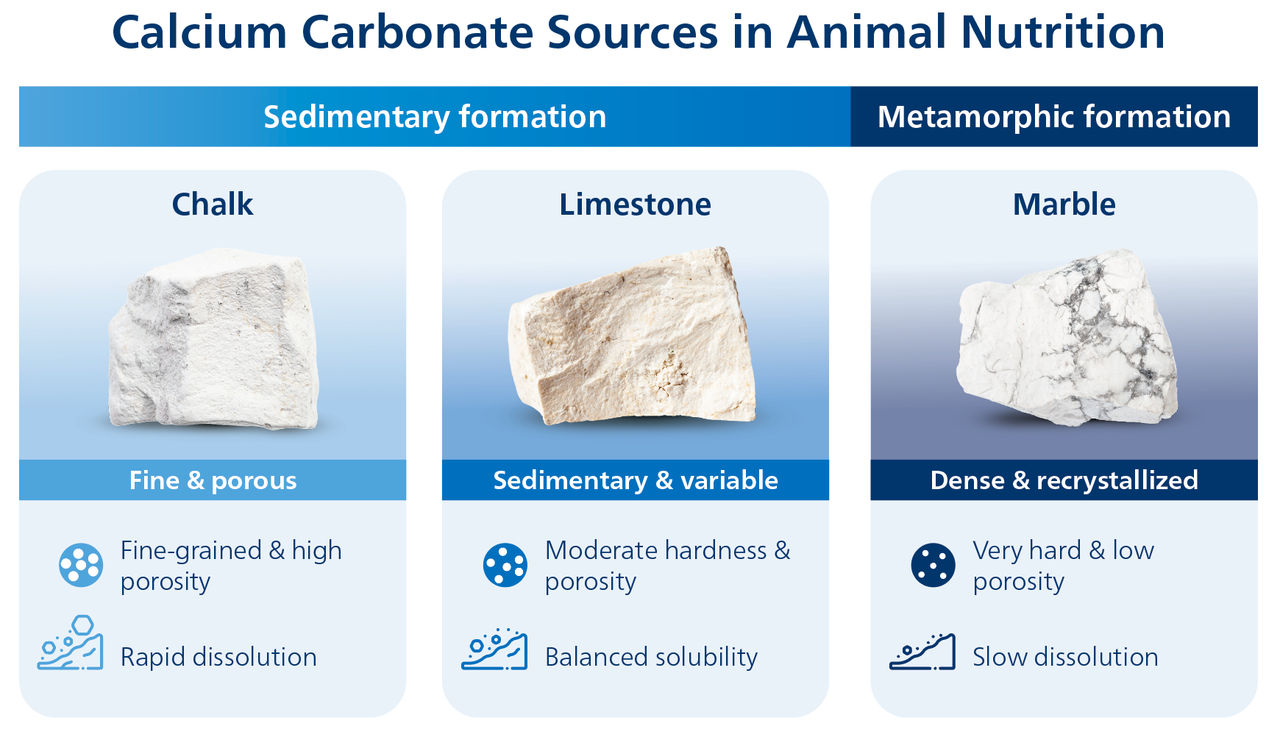
Solubility determines how quickly calcium becomes absorbable. It depends not only on chemistry but also on physical structure, including porosity, crystal form, and surface area. Different CaCO₃ sources dissolve at different rates, shaping calcium digestibility, bone mineralization, and eggshell quality. Together, these characteristics determine how much calcium is actually available to the animal not just how much is added to the formulation.