

Wastewater treatment plants worldwide are under increasing pressure as nutrient discharge limits tighten and environmental expectations evolve. Across Europe, the United States, and many national jurisdictions, utilities are being pushed toward lower ammonia, nitrite, and total nitrogen- as well as phosphate and total phosphorus- discharge targets. In addition, water consumption has decreased in many regions, which results in higher pollutant inflow concentrations, both for municipal and industrial applications. Effluent limits, however, are usually based on pollutant concentrations and not on loads. In turn, many installations today face more demanding removal efficiencies. This shift demands a much more stable biological process than what many conventional activated sludge systems were originally designed for.
Of all the parameters influencing nitrification a key step in nitrogen removal, alkalinity is often overlooked, yet it plays a central role in keeping microbial communities functioning. In many plants, pH instability has quietly become one of the most significant disruptors of biological performance, especially in soft-water regions or where ferric salts are used to achieve low phosphorus limits. The result is an increasingly common operational reality: nitrification that is theoretically achievable but practically unstable.
A process under stress: why alkalinity becomes limiting
Nitrification naturally consumes alkalinity, about 7.14 mg as CaCO₃ per mg of ammonium oxidized and when the system can’t keep up, pH begins to fall. Even small shifts are enough to slow nitrifying bacteria and trigger instability. In practice, this shows up quickly in plants with soft influent water or those relying on ferric/alum for low P limits, both of which accelerate alkalinity depletion.
A low alkalinity environment doesn’t just weaken nitrification; it also increases the risk of nitrite accumulation and can elevate N₂O emissions, adding a climate impact dimension to what used to be considered a simple process-control issue.
The core challenges come down to:
Fast alkalinity loss: 7.14 mg alkalinity as CaCO₃ consumed per mg NH₄N drives pH down.
Sensitive biology: AOB and NOB slow as pH slips below ~7.2.
Soft water + ferric dosing: Low starting alkalinity + coagulant demand narrows the safety margin.
Climate impact: Low pH conditions can drive higher N₂O emissions.
Together, these factors make alkalinity control a critical lever for maintaining biological stability.
The case for calcium carbonate as a biological buffer
Many plants turn to caustic soda or hydrated lime to manage pH, but these chemicals often create more volatility than stability. Because they dissolve instantly, they can trigger rapid pH spikes and localized pH peaks. Additionally, they provide ongoing safety challenges for operators for their storage and dosing. More importantly, they only correct the symptom: low pH’, without improving the biological resilience of the system.
Calcium carbonate offers a fundamentally different approach. It dissolves only in the presence of acidity, releasing alkalinity gradually and exactly where it is needed. This self-regulating behavior stabilizes pH both at the tank level and within the micro-zones inside sludge flocs where nitrifiers live. At the same time, calcium ions strengthen the floc matrix by binding to negatively charged biopolymers, creating denser, more compact flocs that settle and dewater more effectively.
Because of this dual chemical and biological benefit, mineral alkalinity has become increasingly attractive to utilities seeking a more stable, predictable, and operator friendly way to support nitrification. Instead of sharp corrections and process swings, plants experience a smoother, more resilient biological environment that performs consistently under changing conditions.
Full-scale evidence from municipal operations
A recent two-month municipal trial shows how calcium carbonate-based buffering can improve biological stability, nutrient removal, and membrane performance in real world wastewater conditions. The facility operated membrane bioreactors with ferric-based phosphorus removal an approach that consumes alkalinity and depresses pH, especially when chemical dosing increases during periods of higher load. To avoid relying on caustic soda, operators introduced Omya Optical directly after primary clarification.
Once the dosing rate was optimized, the biological system immediately became more stable. pH remained within the target range of 7.0–8.0, and alkalinity consistently reached the plant’s preferred 40–60 mg/L as CaCO₃ range, with values up to 100 mg/L. This stable buffering environment supported both the activated sludge process and downstream membrane filtration.
Phosphorus removal performance strengthened as well. Orthophosphate concentrations stayed below the 0.2 mg/L permit limit throughout the optimized phase of the trial - something the plant struggled to achieve when alkalinity was low or dosing was inconsistent. Early underdosing made the contrast clear: compliance only stabilized once sufficient mineral buffering was established.
The membranes also responded positively. Calcium from Omya Optical bound with dissolved microbial substances, reducing organic fouling and improving permeability. This allowed the MBR system to operate more consistently, with fewer fluctuations in filtration performance.
To illustrate the performance shift, the data showed:
pH stabilized within the 7.0–8.0 operational target, supporting the biological process.
Alkalinity reached and maintained 40–60 mg/L as CaCO₃, ensuring stable buffering.
Orthophosphate stayed below 0.2 mg/L, meeting a stringent discharge requirement.
Membrane fouling decreased, improving permeability and filtration stability.
These improvements resulted not only from the alkalinity provided, but also from calcium’s role in improving floc structure and membrane behavior. By replacing caustic soda with a mineral-based alkalinity source, the utility strengthened biological stability, reduced operational risk, and supported reliable compliance- key advantages for municipal plants facing tighter nutrient limits and rising performance pressures.
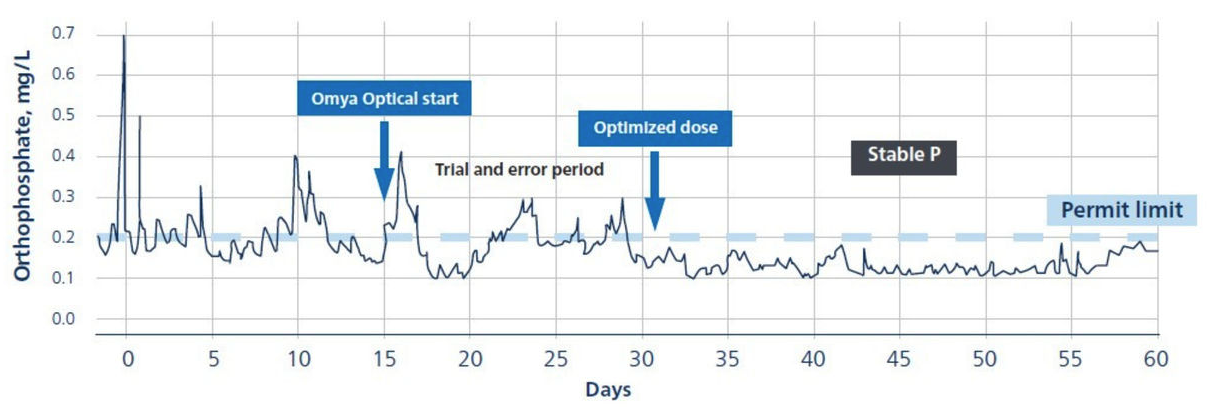 Fig.1: Phosphorus removal. Once the Omya Optical dosage was optimized, the phosphorus (measured as orthophosphate) concentrations remained below the 0.2 mg/L permit limit.
Omya Optical: a mineral approach aligned with modern wastewater challenges
Omya Optical provides alkalinity in a natural, controlled way that supports stable nitrification without the sharp pH swings or safety concerns linked to caustic chemicals. Because it dissolves only when acidity is present, it releases alkalinity steadily and keeps the biological process in balance.
At the same time, Omya Optical supplies calcium that naturally strengthens sludge flocs. This creates denser, more compact structures that settle more reliably, a real advantage during ferric dosing, stormwater dilution, variable loading or cold weather.
In practice, Omya Optical brings together three benefits that operators immediately notice:
Stable, demand driven alkalinity that avoids pH overshoot
Stronger, more resilient flocs thanks to calcium reinforcement
A safer, more sustainable alternative to conventional alkaline chemicals
These improvements also extend to the environment. Higher effluent alkalinity helps receiving waters maintain a stable pH and promotes the conversion of dissolved CO₂ into bicarbonate, supporting long term ecosystem health.
A smarter foundation for stable biology
Alkalinity has become one of the most decisive factors in keeping activated sludge systems reliable. By supporting nitrification, strengthening sludge structure, and reducing the risk of pH-driven instability, mineral buffering helps plants stay compliant and resilient under increasing operational pressure.
Omya Optical offers a simple, natural way to stabilize the biology and improve the performance, not by masking symptoms, but by enhancing resilience and reinforcing the process where it matters.
Ready to strengthen your plant’s biological stability with a safer, natural alkalinity source? Let’s explore how Omya can support your operations.