Limitations of caustic soda and conventional lime
Operationally, caustic soda (NaOH) poses several well‑known constraints. Its corrosive nature requires strict handling and exposes workers and infrastructure to significant safety risks. Chemically, its high sodium load can interfere with downstream biological stages and elevate conductivity, effects observed in industrial settings where NaOH dosing negatively impacted process stability and effluent quality.
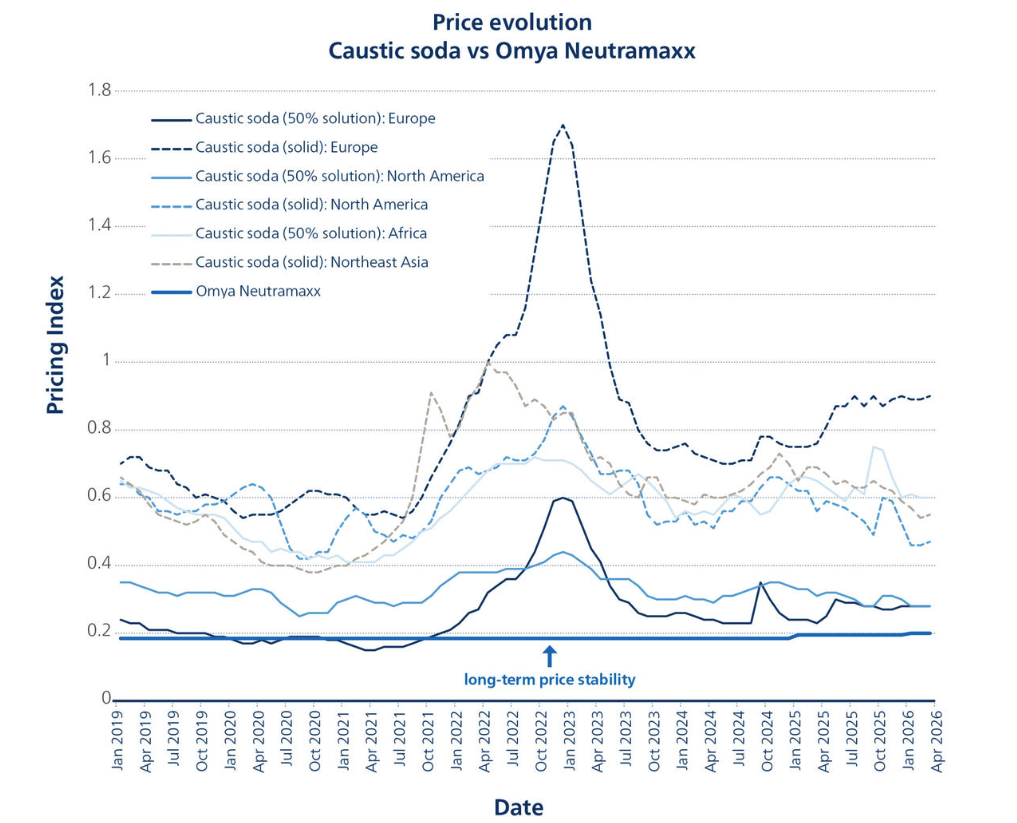
Traditional lime comes with different but equally limiting issues: rapid settling, clogging of equipment, inconsistent slurry behavior, and high maintenance requirements. As treatment plants strive for stable operations, predictable dosing, and reduced carbon footprint, these drawbacks are increasingly difficult to justify, especially in a market where resin‑based, energy‑intensive caustic soda production amplifies both cost and environmental exposure.
This combination of operational friction, safety concerns, and supply‑chain volatility has opened the door for next‑generation neutralization solutions.
What real‑world trials reveal: data‑backed performance across industries
As utilities and industrial operators reassess the long‑term viability of sodium‑based neutralization, real‑world trials offer a clear picture of what modern, calcium‑based chemistry can deliver. Across paper & board, electronics manufacturing, and food & beverage processing, Omya Neutramaxx consistently outperformed caustic soda—not only in operational stability but also in measurable technical indicators that directly influence treatment performance and cost
Paper & board: stabilizing the entire water cycle
In corrugated board manufacturing, operators had long struggled with elevated conductivity and unstable settling behavior driven by the sodium load of caustic soda. Replacing NaOH with Omya Neutramaxx led to higher pH stability and consistently lower conductivity throughout the recycled pulp water loop. This shift translated into a 30% reduction in chlorine dioxide consumption, driven by improved water chemistry and more resilient microbial activity. At the same time, the calcium–sodium ratio increased from 0.5 to 2, improving floc formation and reducing sludge volume in the activated sludge system, an effect operators immediately recognized in clarifier performance.
Electronics / Printed Circuit Board (PCB): lower consumption with full compliance
In copper‑rich wastewater from PCB production, Omya Neutramaxx demonstrated that a reactive lime suspension can deliver precise, repeatable pH control even under highly variable acidic loads. Plants recorded 35–37% lower mass and volume consumption compared with 32% caustic soda, while maintaining the required pH window of 10.5–11.8 for metal precipitation. Importantly, copper and nickel concentrations remained within compliance levels (Cu < 0.5 mg/L, Ni < 0.1 mg/L), matching the performance of caustic soda without the operational drawbacks. Operators also noted improved equipment reliability, as the slurry‑compatible peristaltic dosing setup avoided the pump blockages that had frequently occurred with NaOH.
Food & Beverage: cleaner effluent, less sludge, lower total costs
In high‑organic meat and pasta wastewater, switching from sodium hydroxide to Omya Neutramaxx reduced product consumption by 11%, while delivering more stable pH behavior within the two‑stage flotation process. Effluent parameters improved across the board: COD, TN, and TP concentrations all decreased, indicating more efficient coagulation and flocculation due to the contribution of calcium ions. Sludge management benefitted as well, disposal volumes dropped by 21% thanks to higher solids content in the thickened sludge. Combined with lower chemical consumption, the trial partner achieved €40,000 in annual savings, highlighting the economic strength of the transition.
A Data‑Driven Pattern: Less Sodium, More Stability, Lower Risk
Although the industries and wastewater profiles differ significantly, the trial results point to a consistent transformation:
In every case, the shift away from caustic soda did more than replace a chemical—it stabilized the wider treatment ecosystem
A new standard for utilities and a path forward
As operational pressure, safety expectations, and sustainability goals continue to rise, utilities are increasingly shifting toward solutions that deliver predictable performance without exposing plants to the volatility of global caustic soda supply chains. Omya Neutramaxx, a highly stable and reactive milk‑of‑lime suspension, provides this balance: a safer handling profile, long‑term storage stability without agitation, neutralization performance equivalent to 50% caustic soda, and significantly improved downstream process behavior.
For utilities evaluating the future of their pH‑control strategy, the conclusion is clear: reactive lime‑based systems such as Omya Neutramaxx offer a resilient, efficient, and sustainable alternative to traditional chemicals, reducing dependency on vulnerable supply chains while enhancing overall treatment performance.
Want to explore how a modern neutralization approach could support your plant?
Omya provides technical evaluations, trial support, and process‑specific recommendations to help utilities transition to safer, more efficient pH control. Contact us.