Could poor soil sampling become a $100,000 mistake?
A soil sample may represent only a small portion of a field, but the results can influence decisions across hundreds or even thousands of acres. From lime applications to fertilizer programs and nutrient management, reliable recommendations start with one essential step: collecting a representative soil sample. In a recent Omya webinar, Tim Radmacher, Lead Field Representative at Midwest Laboratories, shared practical guidance on soil sampling and soil-test interpretation. With more than 1.8 million soil samples processed annually, Midwest Laboratories brings extensive experience in understanding how sampling practices can influence the quality of the information growers receive.
What can a poor soil sample really cost?
The financial impact of an inaccurate soil sample will vary by crop, region and farming system. However, a hypothetical US corn example illustrates how sampling accuracy can influence both agronomic and financial decisions. On a 1,000-acre (approximately 405-hectare) corn farm, annual fertilizer investment may exceed $200,000. If soil sampling does not adequately represent field variability, the resulting analysis can lead to very different management decisions. For example, excluding low or wet areas could result in a reported soil pH of 6.2, leading the grower to conclude that a lime application is unnecessary. At an assumed application cost of $65 per acre (approximately $161/ha), this would represent an apparent saving of $65,000 across the farm. If a more representative grid sampling approach instead indicated an average soil pH closer to 5.7, the agronomic picture would be very different. Soil acidity can reduce nutrient availability and affect crop performance. In this hypothetical scenario, a resulting revenue loss of $165,000 would turn the initial $65,000 saving into a $100,000 net loss.
While the figures will differ between markets and farming systems, the principle is universal: a small soil sample can influence decisions across hundreds of hectares. Representative sampling provides a more reliable basis for liming, fertilizer and nutrient-management decisions.
Why is consistency important when taking soil samples?
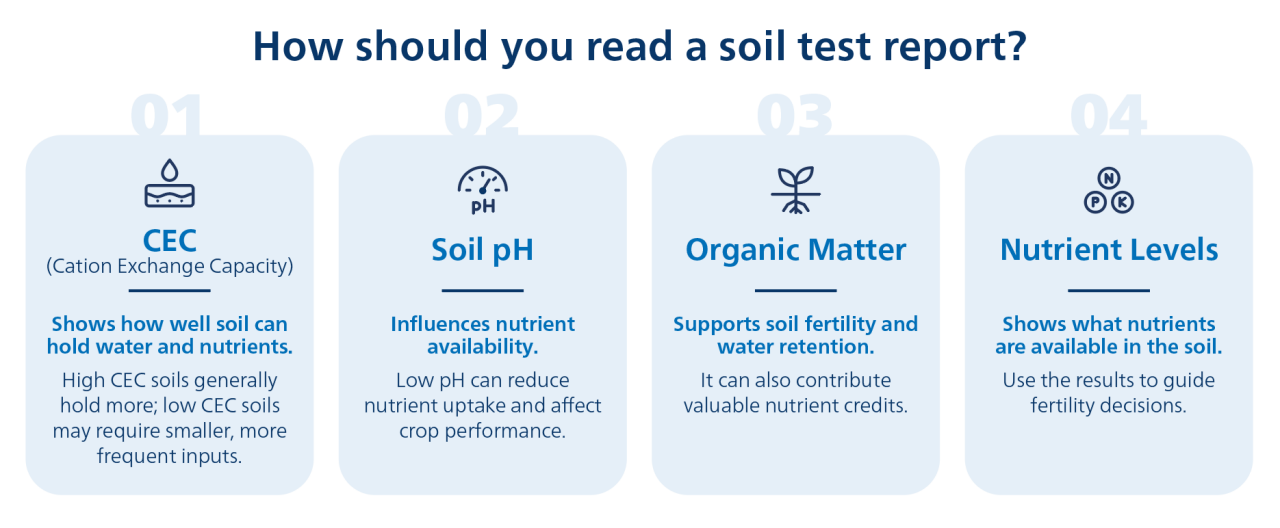
Consistency is essential when soil-test results are used to track changes over time. Differences in sampling depth, timing, soil moisture or field conditions can influence measured nutrient levels and make results from one sampling cycle difficult to compare with another. Using the same sampling depth, similar timing and a consistent methodology provides a more reliable basis for monitoring soil conditions and making lime and fertilizer decisions. Recording when and how samples were collected also helps ensure that future results can be compared on a like-for-like basis. For meaningful year-to-year comparisons, consistency matters as much as the sample itself. A soil test contains a lot of information. Reading the results in a logical order can help build a clearer picture of soil conditions and guide fertility decisions.