Optimizing calcite contactor design for desalinated water remineralization

How EBCT optimization influences operating cost, CO₂ consumption and water quality.

Omyaqua Pure -Detail.jpg
Share

As desalination capacity continues to expand, remineralization is increasingly becoming a process optimization challenge rather than a simple compliance requirement. While target values for calcium, alkalinity and LSI can often be achieved through multiple treatment approaches, significant differences remain in chemical consumption, CO₂ demand, process stability and long-term operating costs. Understanding how design parameters influence these outcomes has become critical for both new installations and plant upgrades.

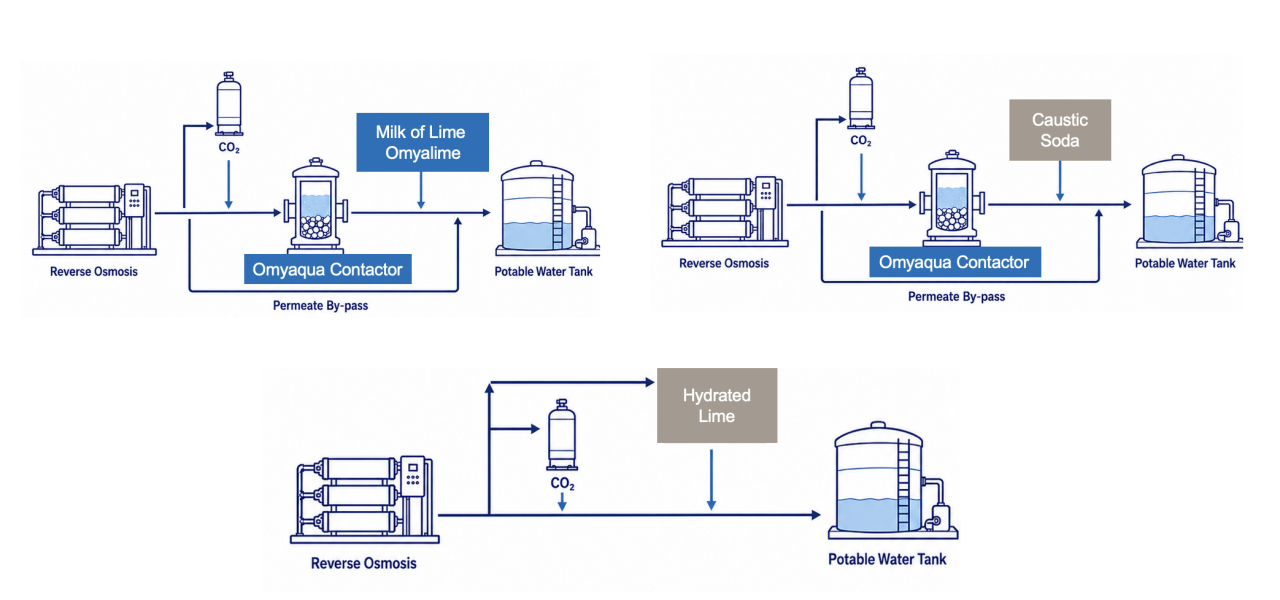
Three practical remineralization approaches were evaluated under identical finished water quality targets to understand how process configuration and contact time influence operating cost and performance.

Remineralization configurations Figure 1. Remineralization configurations evaluated in the modelling study: calcite contactor with milk of lime, calcite contactor with caustic soda, and stand-alone hydrated lime.

EBCT as a key design parameter

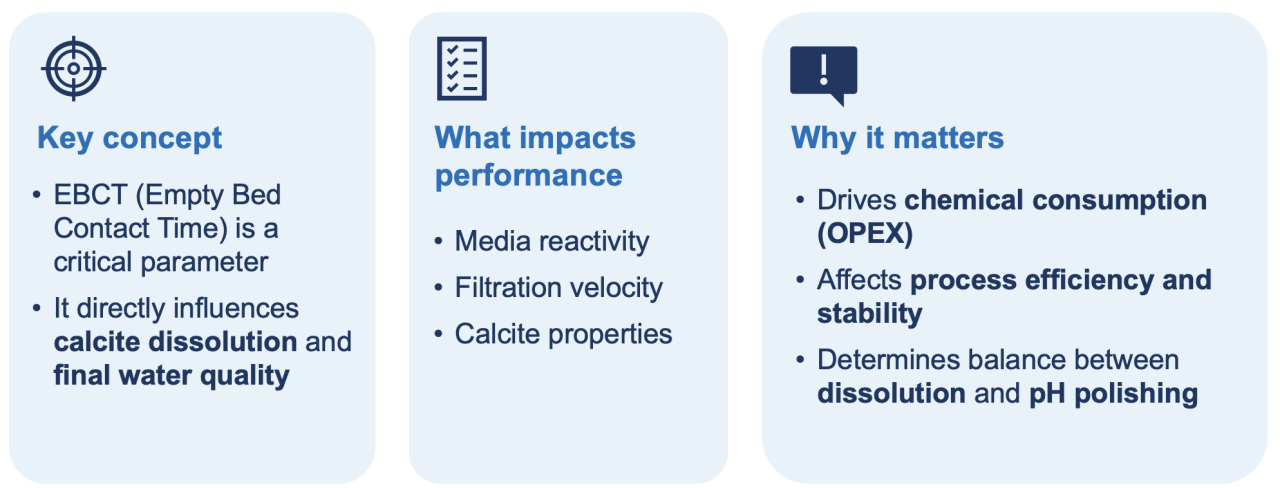
In calcite contactors, EBCT directly influences the dissolution of calcium carbonate and therefore the final water quality. Higher contact time gives the water more opportunity to dissolve calcite inside the contactor, which can reduce the need for downstream pH polishing. However, EBCT also impacts contactor size, hydraulic design and footprint. This makes EBCT a critical engineering parameter, not only an operational setting.

The modelling was performed under standardized target conditions to allow a fair comparison between configurations: temperature of 22 °C, LSI of 0.2, calcium of at least 20 mg/L and alkalinity of 60 mg/L as CaCO₃. The evaluated calcite media was Omyaqua (CaCO3) 2–5 mm, with a purity of 98.2%.

This approach makes it possible to compare different process routes based on the same final water-quality targets, while assessing how EBCT affects chemical demand, CO₂ consumption and total treatment cost. 

EBCT is a key design parameter Figure 2. EBCT is a key design parameter influencing calcite dissolution, process efficiency, water quality and operating costs.
Chemical cost decreases with optimized contact time

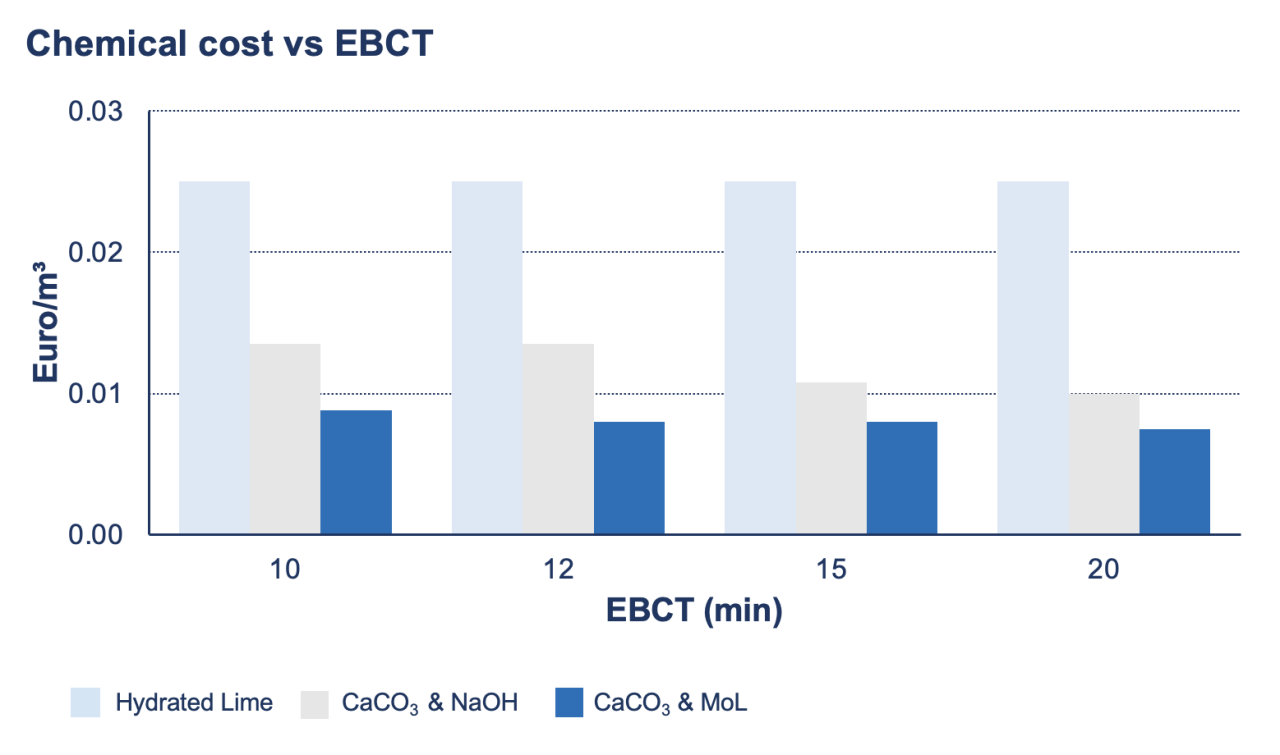
The modelling results demonstrated that EBCT is a key driver for reducing operating cost in calcite contactor systems. As contact time increased, more remineralization occurred within the calcite bed, improving dissolution efficiency and reducing the need for downstream chemical correction.

This translated into lower overall chemical consumption and reduced operating costs. Among the configurations evaluated, the calcite contactor combined with milk of lime consistently achieved the lowest treatment costs across the entire EBCT range, outperforming both the caustic soda and stand-alone hydrated lime alternatives.

The findings highlight a broader principle: process economics depend on the combined interaction of EBCT, calcite dissolution, CO₂ dosing, and pH polishing rather than on the polishing chemical alone. As a result, EBCT should not be viewed solely as a hydraulic design parameter, but as a key optimization lever that directly influences chemical demand, operating costs, and overall process efficiency.

Chemical cost vs EBCT Figure 3. Chemical cost comparison across EBCT values. Calcite contactor combined with milk of lime showed the lowest treatment cost across the evaluated range.
Lower polishing chemical demand supports lower OPEX

The reduction in operating cost is largely driven by a decrease in downstream pH polishing requirements. As EBCT increases, more remineralization takes place within the calcite contactor itself, reducing the amount of chemical adjustment required to achieve the target water quality.

The modelling results showed a consistent reduction in polishing chemical demand for both caustic soda and milk of lime as contact time increased. This confirms that contactor design directly influences downstream chemical consumption and highlights the importance of optimizing dissolution within the calcite bed before relying on post-treatment correction.

For plant operators, the benefits extend beyond chemical cost savings. Lower dosing requirements can also reduce storage needs, handling requirements and operational complexity, contributing to improved process reliability and long-term resilience.

CO₂ demand is also influenced by process configuration

The same optimization principles that reduce polishing chemical demand also influence CO₂ consumption. Because calcite dissolution depends on both contact time and process configuration, improvements in remineralization efficiency can translate into lower CO₂ requirements.

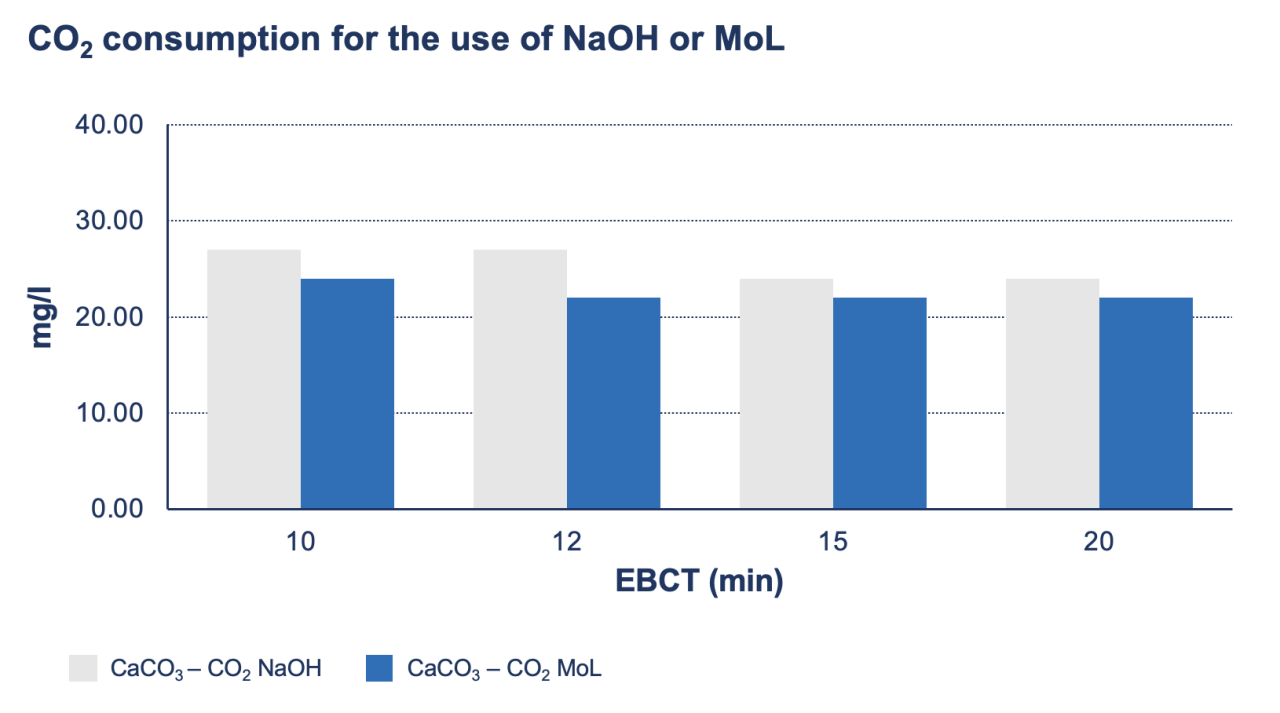
The modelling demonstrated that the calcite contactor combined with milk of lime required less CO₂ than the equivalent caustic soda configuration across the evaluated EBCT range. This reinforces that remineralization performs best when treated as an integrated process rather than a series of independent treatment steps.

From an engineering perspective, effective design brings EBCT, calcite dissolution, CO₂ utilization and pH polishing together to meet water-quality objectives at the lowest practical operating cost. As CO₂ and chemical costs continue to influence desalination economics, understanding these interactions becomes increasingly important when selecting and designing remineralization systems.

CO2 consumption Figure 4. CO₂ consumption varied by process configuration, with the milk of lime route requiring less CO₂ than the caustic soda configuration.
Maintaining water quality while reducing OPEX

Cost optimization must not come at the expense of finished water quality. The modelling results showed that all evaluated configurations were able to achieve the target water quality requirements, while maintaining stable pH levels across the investigated EBCT range.

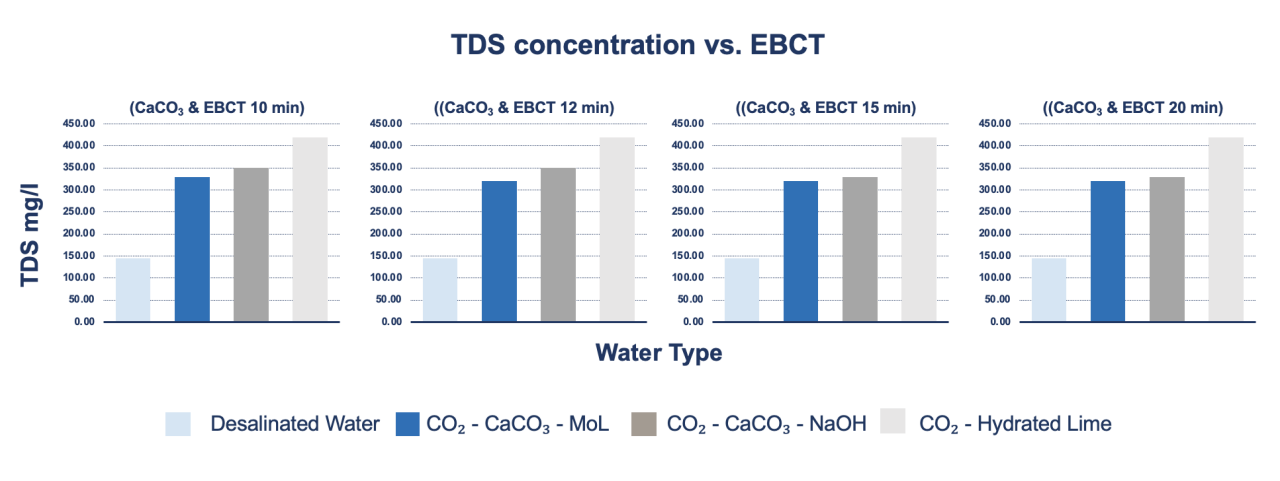
Differences became more apparent when comparing the resulting TDS profiles. The calcite contactor configurations provided a more controlled remineralization profile than the stand-alone hydrated lime approach, which consistently generated higher TDS levels under the same target conditions. This suggests that process configuration influences not only operating costs, but also the overall quality and stability of the remineralized water.

More importantly, lower chemical consumption did not compromise process performance. Instead, the results showed that optimizing the calcite contactor, media characteristics, CO₂ dosing, and polishing strategy as an integrated system improved operating efficiency while maintaining stable water-quality outcomes. This reinforces a key engineering principle: the success of a remineralization process depends on the optimization of the overall treatment train rather than any single operating parameter.

TDS concentration vs EBCT Figure 5. Calcite contactor configurations provided a more controlled TDS profile compared with stand-alone hydrated lime.

From water quality targets to process optimization

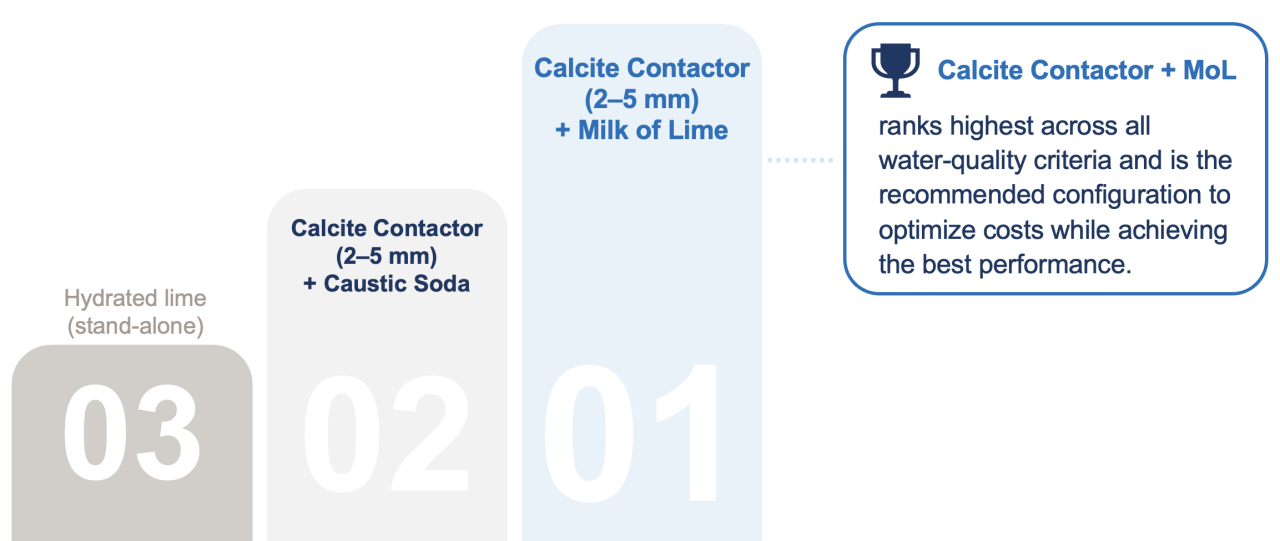
One of the key findings of the study was that multiple remineralization configurations were able to achieve similar drinking water quality targets while operating with significantly different chemical requirements and operating costs. This highlights an important engineering principle: remineralization performance should be assessed not only by final water quality, but also by the efficiency with which those targets are achieved.

The modelling demonstrated that optimizing EBCT, calcite dissolution, CO₂ utilization, and pH polishing together can create opportunities for lower operating costs, improved process stability, and more efficient remineralization performance.

Model ranking Figure 6. Overall model ranking: calcite contactor with milk of lime provided the strongest balance between water quality, chemical consumption and operating cost.
Engineering takeaway

EBCT emerged as one of the most influential design variables in calcite contactor systems. By optimizing contact time alongside calcite media selection, CO₂ dosing and polishing strategy, desalination plants can improve operational efficiency while maintaining stable finished water quality and reducing long-term treatment costs.

Key engineering insights

  • EBCT is the primary design lever affecting remineralization performance.
  • Longer contact times reduce polishing chemical requirements.
  • Optimized calcite contactors lower CO₂ consumption and operating costs.
  • Process configuration affects both economics and final water quality.
  • Modelling enables engineers to identify the best design before implementation.

As desalination projects continue to expand globally, model-based remineralization design can help utilities move beyond compliance-driven treatment toward more efficient, resilient and cost-effective operations. For more information, please contact us

Curious to expand your knowledge?

Click here to read more and stay updated with the latest articles!